By Brad Jones

Woody Wampler has been gold prospecting in Arizona since the 1970s, but it wasn't until last year that he and his pal, Frank Augustine, began finding ounces of gold on their mining claims in the Superstition Mountains.
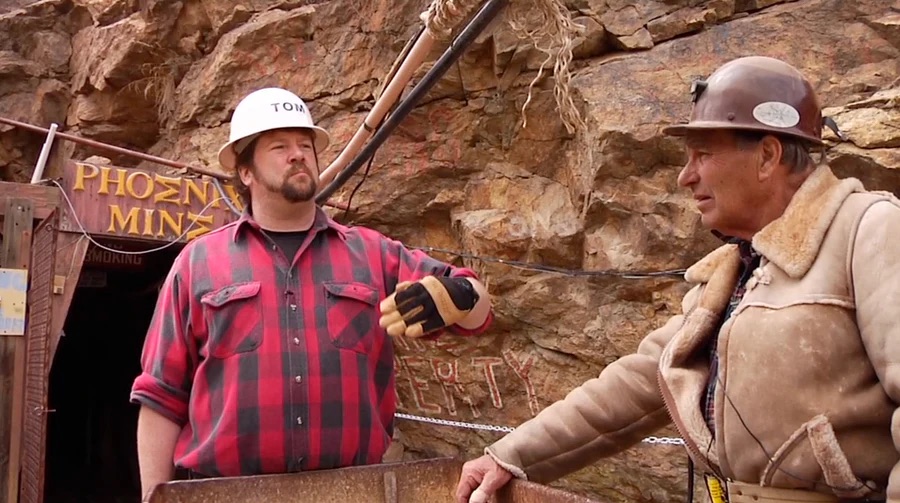
Last summer, these two experienced gold prospectors were chosen to be part of a team led by treasure hunter Wayne Tuttle to search for the legendary Lost Dutchman's Gold Mine. The five-man party was assembled for a new TV series called Legend of the Superstition Mountains which began airing in February on History Channel.
The quest began with Tuttle's lifelong search for the mine — and a map belonging to Augustine. The map was derived from the Peralta Stones, a set of etched stones believed by some treasure seekers to hold the key to the location of the Lost Dutchman's Mine, named after gold prospector Jacob Waltz.
Wampler and Augustine are both longtime members of the Gold Prospectors Association of America and belong to the local GPAA chapter based in Phoenix. Augustine has researched many of the legends of the Superstitions from the books of Tom Kollenborn and Jack San Felice, including the Lost Dutchman's Gold Mine, but he had never set out to search for it until last summer. Both men are thrilled to be part of Tuttle's quest, which they say has been an adventure of a lifetime.
Who was the Lost Dutchman?
Curiously, Jacob Waltz was a German immigrant — not Dutch. (Germans were often mistakenly called Dutchmen in America during the mid-1800s.) He was born near Oberschwandorf, Wurttenburg, Germany some time between 1808 and 1810. The actual date of his birth is believed to be undocumented. He immigrated to the United States in 1839 but did not become a naturalized citizen until 1861.
By 1864, Waltz was known to be prospecting in Arizona and it is believed he uncovered a rich gold deposit somewhere in the vicinity of the Superstition Mountains. The find is now known as the legendary Lost Dutchman Mine.
In 1868, Jacob Waltz was living modestly as a farmer on the Salt River which runs through Phoenix. He died on Oct.13, 1891 and was buried in City Cemetery.
Waltz is said to have told many tall tales about his prospecting exploits and shared clues to the gold mine's location that have tormented treasure hunters ever since.
Indian legends and cursed gold
The Apache Indians and ancient tribes were probably the first people to lay eyes on the Superstitions, followed by the Spanish conquistadors, the first of whom was Francisco Vasquez de Coronado, who journeyed north from Mexico in search of the fabled Seven Cities of Gold, in 1540. When the Spaniard reached the Superstitions, the Indians told him the mountains held plenty of gold, but refused to help him explore this forbidden land, which was said to be home to the Apache thunder god.
Some Apaches believe that hidden in these treacherous hills lies a passage to the underworld. Tales of ancient tunnels abound, including one that says legendary Apache warrior, Geronimo, vanished into the rock walls of these mountains only to reappear days later in New Mexico.
The Superstitions are cloaked in a blood-stained shroud of murder, mayhem and mystique and some treasure hunters believe they are cursed. Over the years, many who have sought the Lost Dutchman's gold have returned with reports of equipment failing, mysterious disappearances, murders and ghost sightings. Some say the spirits of the dead haunt the mountains.
One Indian legend says the treasures of the Superstitions are guarded by Tuar-Tums or "Little People" who live in caves and tunnels. And then, there are the tales of giants and eye-rolling theories of underground aliens, Bigfoot and even the Abominable Sandman.

The Peralta Stones
Anyone who has done any research on the Lost Dutchman's Mine, has undoubtedly come across the mystery of the Peralta Stones.
The Peraltas, led by aging patriarch Don Miguel Peralta, a Mexican of Spanish descent, is said to have held impressive investments in land, mining and cattle. Peralta and his sons are believed to have led mining expeditions into the Superstition Mountains during the time of the Mexican-American War, which lasted from spring of 1846 to the fall of 1847.
The Peraltas and those who worked for them were allegedly massacred by the Apaches, but the legend of the stones lives on to this day. The massacre site is believed to be near Goldfield, now an Arizona ghost town turned tourist destination. The stones are said to contain a map, or clues to a map, indicating the whereabouts of the lost mine — and an estimated $200 million in gold! According to local lore, the Peraltas have handed down the stones from generation to generation.
"The stones consist of "two red sandstone tablets and a heart-shaped rock made of red quartzite," according to Wikipedia. Each block is approximately 8.25 inches by 14 inches and two inches thick, weighing about 25 pounds. "Each red stone block is carved with lines and one long line. When the two blocks are placed side by side and the stone heart is inserted the long line has 18 dots pecked into it. This style of map is known as a Post Road Map and it is a style used in Mexico and Spain during the Mexican-American War. Inscribed on the stones is the date 1847, and one stone contains a relief of a heart, which the heart-shaped stone fits perfectly. The heart shape fits neatly in the second stone. The back of the stone that the heart-shaped stone fits into has the outline of a cross carved on the back. The back of the other stone has the word DON carved into it"
Many treasure seekers have their own theories about where the mine may be hidden based on different interpretations of the stones. And, Frank Augustine, is one of them.
The Peralta Stones are now on display at the Arizona Museum of Natural History in Mesa. Ariz.

One of the legends
The connection between Jacob Waltz and the Peralta family is sketchy at best — if it existed at all. A popular version of the legend is that Waltz and another German immigrant named Jacob Weiser had saved the life of a Peralta descendant, also named Miguel Peralta, who was allegedly stabbed in Mexico by a card dealer whom he had called a cheat. In appreciation, Peralta told Waltz and Weiser of rich gold deposits, known as the Sombrero Mines, or Las Minas de las Sombreras, supposedly named for a prominent hat-shaped mountain peak.
As the story goes, the three men — Waltz, Weiser and Peralta — recovered about $60,000 worth of gold. Peralta then convinced his new German friends to pay him their share of the gold in return for the deed to the mines. And, so they agreed. Waltz and Weiser planned to return to the mine, which they later did.
But, after an unfortunate series of events, including Indian attacks and shootings, Peralta and Weiser were both killed and Waltz was said to have fled to Mexico with the treasure map and as much gold as he could carry.
Waltz later returned to Arizona, where he lived as a farmer on the banks of the Salt River, which runs through Phoenix.
In his later years, Waltz, rather than taking the legend of the lost mine to his grave, reportedly told the story to a woman by the name of Julia Thomas and shared the map with her.
Waltz eventually died of pneumonia.
After trying unsuccessfully to organize a search for the mine, Thomas ended up selling copies of the maps for $7 apiece, according to legend.
Though many treasure hunters have since tried to find the treasure, many have died mysteriously and many others have just given up. Nary a one has found even one flake of the Dutchman's lost gold and lived to tell the tale — or, at least, no one has reported any such discovery.
Today's prospectors
On the show, Woody is portrayed as a wary prospector who is always looking over his shoulder, but is he really that spooked and ... well ... superstitious?
"Well, I'm a lot that way," Wampler said. "I do believe in spirits and the Superstition Mountains are very, very dangerous. I've been going out there for many years, and I've seen a lot of crazy things happen. I've seen a [Mohave Green] rattlesnake go out of its way on a 90-degree angle and chase Frank last summer — a lot of weird things ... I've got some things I could tell you about the spirits and stuff out there but it would make your hair curl up."
Some of those tales may be best left to share around a campfire, or at least in private among close prospecting friends.
"If I told you, people would think I'm looney tunes ... but I believe in the Peraltas and that they were massacred," he said. "There are so many stories about the
Superstition Mountains. And, the stories are kinda like fish stories. Every time you hear one, it's a little bit different and the fish got a little bit bigger."
But, Wampler said some of the explanations for the mysterious deaths just don't add up.
"It's kinda hard to say it's suicide when a guy is holding a 22-calibre pistol in his hand and he has a 45-caliber bullet shot through his head," he said, breaking out into a nervous cackle.
"You get the feeling like somebody is watching you and usually there is. I get that feeling really strongly when I'm up there in the Superstitions. I've always had that."
As a prospector, Wampler said he has always been more interested in finding his own gold deposits than hunting for the Lost Dutchman's Mine.
"I always had it in my mind, but I knew that because of the spirits and all these different things, that so many people who went looking for the Dutchman's Mine died, got lost ... So, when I went looking for gold, I never focused on the Dutchman's Mine for all them years. I was scared to," he said. "But, with a group of people, you can go look for it, y'know."
Go big or go home
Besides prospecting, Wampler has always been an outdoorsman — an angler and a hunter. But, as the years went on, he admits prospecting has become his greatest pursuit.
"I quit hunting probably 10 years ago. I went deer hunting with my son-in-law. I was looking at the dirt, the gravel and the black sands and he said, 'I'm not buying your license no more. You're not even hunting,' " Wampler said.
"I wasn't hunting for deer. I was huntin' for gold," Wampler confessed.
As proud prospectors, both Wampler and Augustine like to explain how prospecting differs from mining to other members of their club.
"I'm always looking for bigger and better gold. We are prospectors — not miners. We've been telling the people in our club that for years ... Some of them keep going back to the same hole, digging the same itty-bitty stuff. Then, they say, 'How come we're not getting big gold?' Well, you gotta go find it. You have to look for it," Wampler said.
"Frank knows he can get gold every time, just like I do. There is plenty of small placer gold, but we're looking for the big stuff. A prospector knows where the gold is at but keeps looking for bigger gold — better gold," he said. "I wanna tell you somethin' ... there's a lot of gold out there. I've had so many people tell me there ain't no gold in the Superstitions, and I say, 'You're right, there ain't none out there," he said, with a sly snicker.
Part of being a successful prospector is developing confidence, and while he may be wary of the unknown, Wampler has learned to believe in himself, his skills and his instincts.
Having a loyal prospecting partner is key — not only for safety, but for sharing the stories of the trail and, of course, the gold! Wampler and Augustine have become the best of friends. And, they literally share common ground on the actual mining claims they've staked together.
"I really like Frank. He's a man you can trust. He saved my life once out there already," Wampler said. "I was hanging off a big cliff and ... he hung onto me and kept me from falling. I can trust him with my life, and if I find a lot of gold he's going to share it with me. "
At 68, climbing up the steep path to his claim is no walk in the park for Wampler. And, on the show, the crew climbs a dry waterfall they believe could lead them to the mother lode.
"Climbing that waterfall is unbelievable," Wampler said. "They didn't think I was gonna make it. I was scared to death because I thought, 'Oh my God, we'll never get back down this thing.' We climbed it right to the top."
The dry falls are not always dry, and Augustine believes the waterfall has acted like a giant sluice box, trapping gold in the crevasses below it for millions of years.
"If you get two inches of rain back there, you will get a 10-foot wall of water coming down, and it moves everything. I went up there in the wash and 10 of the samples had nice gold in it," he said.
"Superstitions gold is very rare. You don't see it out there. Woody and I are finding it, and there's a lot of interest in it ... Everybody wants a piece of Superstitions gold because you just don't find it. Nobody else is getting it. As a matter of fact, I gave several of the old Dutch hunters some of it so they would have some because they've done this their whole lives and didn't have a speck of gold from back in those mountains."
Augustine finds it amazing that people have been hunting the Superstitions for years looking for the lost treasure, when there is plenty of gold to be found.
"I found some rich gold on my second trip in, so that tells me if you are going to do something like this, you should join a group like the GPAA so you can learn what to look for and how to process the material," Augustine said. "Not only do they teach you how to find gold, but you'll also meet some good friends who can help you do that, as in the case of Woody and I."

Prospector meets treasure hunter
Frank Augustine, 65, wasn't always a prospector, though. He was once a police sergeant living back east and a part-time treasure hunter.
"When I was living in Pennsylvania, I belonged to two of the GPAA chapters there, and I was into treasure hunting. I've always done research on Arizona, and my wife, Angie, showed an interest in living here because her brother and sister live here."
When he retired about five years ago, Frank and
Angie moved to Arizona. That's when Frank got involved in the Phoenix chapter of the GPAA.
"I needed to learn how to prospect, because that's much different than treasure hunting, so one of the things that I did was join the Phoenix Chapter," he said.
He went on outings and learned from experienced prospectors — guys like Woody Wampler.
"I would keep an eye out for who was most successful and watch what they did. It gave me some lessons ... One of the problem with most Dutch hunters is they know nothing about prospecting, so how are you going to find the Lost Dutchman's Gold Mine if you don't know how to prospect?" he said. "And, what better way to learn how to prospect than to join the GPAA?"
Treasure hunting in his blood
As much as Augustine has embraced gold prospecting as a new chapter in his life, he has never closed the book on treasure hunting and got to know Tom Kollenborn, a historian and expert on the Lost Dutchman's Gold Mine.
"Tom was a policeman for the state of Arizona for a few years so we had something in common and we hit it off right away," he said.
Augustine also got to know another author/historian, Jack San Felice, who is an authority on the Superstitions and the lost mine, and attended one of his classes.
"I came to the conclusion that the eastern Superstitions, which are heavily mineralized — there are a lot of gold mines back in there — would be a good place to look for gold," Augustine said. "And, on my second trip into the area, I discovered a rich placer deposit. The area was unclaimed, so I claimed it. Later on, Woody got involved with the claim."
Augustine and Wampler now have two claims in the Superstitions.
"We have two claims back in the Superstitions and both of them have produced really nice placer gold," Augustine said. "On one claim in about an hour in one five-gallon bucket of dirt, we got four ounces of gold."
It wasn't long before Augustine's prospecting adventure's led him back to thoughts the 'Holy Grail' of lost treasure mysteries he had read about back east. What if he could trace the placer gold deposits from his mining claim to the lode source? And, what if the trail of nuggets, and source could lead him to the legendary Lost Dutchman's Gold Mine?
Through research, Augustine believes Waltz once passed through the area where he and Wampler now prospect for gold, and that the trail of gold Waltz found eventually led him to the lode source, now known as the Lost Dutchman's Mine.
"He was seen going into that area; he was seen coming out of that area, and he had a drywasher made a little bit south of the area," Augustine said. "And, why would he need a drywasher? To get the type of gold Woody and I are getting.
"Where is he going to go? He is not going to go into the main volcano of the Superstitions. There's nothing there. It's a caldera of lava and whatnot," Augustine said. "But in the eastern Superstitions, to this day, there are some old Spanish mines back there that you can still go to ... I've found some of them myself."
Augustine said he has also found pottery and
petraglyphs from the Salado Indians who inhabited the Superstitions until the 15th century.
After some more research, Augustine eventually acquired a rare map based on an interpretation of the Peralta Stones — a map that he believes will lead Tuttle and his crew to the Dutchman's lost gold mine.
"One of the problems with the Superstitions is that the terrain is extreme and people go back there looking for the Lost Dutchman's Mine or various treasures they've read about and something happens to 'em," he said. "Some of them disappear, some of them have little accidents and die, and so you have a continuing history of dead people being found back there."
As recently as January 2011, The Arizona Republic reported that the bodies of three missing hikers into the Superstitions were found about six months after they went missing the previous July. The three day hikers were
inadequately equipped — not enough water or proper gear for the weather and terrain.
On July 29, 2012 USA Today reported that, "Tom
Kollenborn, a local historian and author on the Superstitions, estimates that between the years 1900 and 2000 at least 50, maybe as many as 70, people went into the mountains and never came out. He hasn't fully researched the past 12 years, but could name nine fatalities off the top of his head."
"If you look a little further back to the 1950s and '60s, there were a lot of people shot back there. They've found people with their heads missing — their bodies in one place and their heads somewhere else," Augustine said. "There is a long list of people who never made it out of those mountains."
The mountains also attract strange people who want to get off the grid — some with mental problems — who are antisocial misfits, Augustine said.
"There are some people who are not 'all there' who actually live out there. And, if you get too close to their spot — they think they've found the Lost Dutchman's Mine and you're trying to steal from them — you'll go missing," he said.
Even with his no-nonsense, fact-based background
as a police detective, Augustine believes strongly in the supernatural, and has his fair share of ghost stories to tell.
"The area is definitely haunted," he said.
After listening to some of the tales of witches, ghosts and reptilian beings, Augustine said, "I sat down and told myself, 'You know what? I'm going to need a bigger gun.' "
Spreading the fever starts with a pan
Wampler was an experienced prospector before he joined the Phoenix chapter — but he went to the school of hard knocks.
"I've done everything wrong in the book that you can do wrong prospecting, and that's how I learned. When I first went prospecting nobody told me what I was doing wrong. They'd watch me pull a little bit of gold out, and when I'd leave, they'd go get the gold I missed. For a long time I didn't find no gold. But, it's not that I couldn't find it; I wasn't able to keep it when I did find it."
Wampler has learned to properly set up equipment and take his time panning to make sure he isn't losing gold.
"Now, I teach people how to find the gold, where to find it, how to read the creeks, what kind of equipment to get into, the whole shebang, right down to putting it in the vial from the black sands. I've got a unique way of panning," he said.
Even if you're lucky enough to learn from a skilled gold panner who takes the time to explain each step, watching someone else pan will only take you so far. The rest is up to you.
"There are so many things people don't see about what's going on in the pan in the water watching someone else do it," Wampler said.
You simply have to hold the pan in your hands to get a feel for how the dirt, water, black sands and gold interact in the pan.
"I see people throw gold away all the time," he said, with a chuckle. "They throw it out of the pans, the drywashers and everything because they don't know how to run 'em. And, that's what's sad. A lot of people can't seem to separate the gold from the black sands. But, it's just a matter of having patience and learnin' how to do it."
Gold & Treasure Show in Mesa, Ariz.
Both he and Augustine are longtime GPAA members and enjoy spreading gold fever at the GPAA's annual Gold & Treasure Show in Mesa, Ariz. every year. They are volunteers and work with other members of the Phoenix chapter to teach prospecting to showgoers and invite them to become GPAA members.
"I always help set up and tear down at the show in Mesa," he said. "That's what I'm all about. I am 100 percent pro-GPAA and I always have been. I promote it. That's just what I do."
Wampler said he especially loves showing whole families how to pan and find gold.
"I show them that a five-year-old can do the same as a 65-year-old and be just as involved in it. And, that's what's important," he said.
More than just a club
Wampler has been a GPAA member for more than 20 years and both he and his wife, Jean, love their club and the members they've met over the years.
"She's just as involved as I am in the club. She loves the club just like I do," he said. "It's not a club. It's a home. It's a family. I love my chapter with all my heart. They are the greatest people in the whole world."
Going prospecting with a GPAA chapter is a great experience for families, and our members have hearts of gold when it comes to teaching kids. To pass down a hands-on, living legacy of the gold prospector as playing a key role in the exploration of America, our culture and heritage, the club often invites groups like the Boy Scouts and Girl Scouts to outings and goes to schools.
"This May, we'll be teaching fourth, fifth and sixth graders up in Humboldt how to prospect for gold ... These guys from Phoenix will drive 100 miles just to teach some kids how to pan for gold. That's dedication!" Wampler said.
As one of the event coordinators for the Phoenix chapter, Wampler helps to plan outings and both he and Jean enjoy attending chapter meetings.
"You get pumped from the energy ... People feel the positive energy in the club," he said. "They are loving, caring and will give you the shirts off their backs. I've met lots of friends that will do anything in the world for me, and that's hard to come by."
And, every year, Wampler invites up to 70 club members to several outings on his five-acre property near Prescott, Ariz.
Exploring the Superstitions
Wampler said he and Augustine are planning to take some Phoenix GPAA chapter members back further into the Superstitions for a tour of their claims.
"I want to show them the big arches with holes in them and how beautiful it is back there, and show them the claims. It's like a whole other world out there. And, even as dangerous as it is, you know what, when I go out there, it's pretty exciting," he said. "I've gone up on the east side and followed the trail all the way to the west side of the Superstitions. It's a trip on it's own just to take a drive back there. It's an all-day drive."
Even after years of prospecting in the Superstitions, Wampler says it's never a good idea to stray too far off the beaten path.
"That's how people die," he said. "I'm not getting off the trail and end up in a bad situation. That ain't gonna happen."
The good, the bad and the ugly
History tells us that gold fever brings out the best and the worst in people, and some people get downright ugly.
"People will follow you to find your gold. If you find good gold, people will do anything in the world to see where you're getting it. They followed the Dutchman and everybody else. It's been that way forever," Wampler said. "I've learned to stay away from those kinds of people. That's the way it is and you're always going to have 'em."
But, for Wampler, the good outweighs both the bad and the ugly side of gold fever. He says it's not about greed, but about learning how to share.
"You have people who give their gold away, and I've given away a lot of gold," he said, proving the theory, "It's not about having the gold; it's about finding the gold."
For him, getting close to nature on the land, is invigorating and even the act of panning itself can be therapeutic.
"You can feel all of your burdens just roll off you ... When I get stressed out, I just go out and freakin' pan — pan, pan, pan and not worry about anything. I take a break and get away," he said. "I just think it's the greatest thing in the world and that everybody should do it. I don't know why everybody doesn't do it. It's good for the soul."
Brad Jones is the Managing Editor/Communications Director for the Gold Prospectors Association of America and the Lost Dutchman's Mining Association. He can be reached at bjones@goldprospectors.org.
Photos courtesy of The History Channel / Matthew McDermott, Frank Augustine and Wikipedia
.png)