By Brad Jones
Not far from Dahlonega, lies one of Georgia's oldest gold mines, steeped in some of the state's richest history — and color.
Founded in 1847, Crisson Gold Mine was operated commercially until the 1980s. The mine, which has been open to the public since 1969, features a 128-year-old, 10-stamp mill that is still used to crush gold-bearing quartz into ore. To the delight of both greenhorns and serious gold panners, antique rod mills and jaw crushers are also operational and are powered up on occasion.
Rich history of the mine
The history of the open-pit mine runs fathoms deep from France to piracy on the high seas to the coasts of Bermuda and the Carolinas to Georgia, the American Civil War and even California.
In her book, I Remember Dahlonega, historian and author Anne Dismukes Amerson interviews John Reese Crisson, the last member of the Crisson family to own the mine. The book is a collection of stories as told to her by local residents. In a recent interview with Gold Prospectors magazine, Amerson recalled her conversations with Crisson in which he retraced his family history back to Bermuda.
According to legend, the original Crisson, whose first name is unknown, was a French sea captain sailing under British colors. In the early 1700s, he was captured by pirates off the coast of Bermuda and forced to walk the plank, but his son's life was spared.
Crisson's son, whose first name is also unknown, was put ashore in Bermuda. He married a woman there and had five sons, one of whom was a wanderer and disappeared.
The missing son, Elijah Crisson, ended up in the Carolinas and later made his way to Georgia, where he worked as a gold miner in the 1820s. At the height of Georgia's gold rush, Crisson pulled up stakes and headed West with his eldest son. Legend has it that Elijah had planned to send for his family once he got out West, but was never heard from again.
According to Amerson, John Crisson told her that the Crisson family in Bermuda had heard of the Crisson family in Dahlonega and contacted them. It wasn't long before both families realized they shared common ancestry.
Quoting the words of John Reese Crisson, Amerson said:
"In the early 1700s, a Frenchman named Crisson was captain of a ship flying under the English flag when it was captured by pirates off the coast of Bermuda.
"It was the pirates' custom to force the crew of the captured ship to walk the plank and then scuttle the ship after offloading any cargo of value. In going through the sea trunks, the pirate captain found evidence that the other captain was a Mason, and being a Mason himself, he agreed to spare the life of the captured captain's son, who was also aboard.
"After seeing his father walk the plank to a watery death, the young son was put ashore in Bermuda. He married there and had five sons, one of whom was a wanderer, who emigrated to the Carolinas and was never heard from again.
"Where their knowledge of family history ended, ours began, because that wanderer was Great, Great Grandpa Elijah."
"That's what John told me. And, what I've done in my interviews for articles is to just let people tell the stories. I can't vouch for the veracity of it, but it's something that has been passed down in their family, so I'm inclined to think there is at least some truth in it," Amerson said.
William Reese Crisson, Elijah's younger son, born about 1818 near Tanyard Branch on Yahoola River, was just 12 years old when his father left Georgia. Records show that he helped clear land and worked on the first log courthouse in Lumpkin County in 1833. Like others in the east, he headed West in search of gold in 1850, but returned to Georgia to become a captain in the Confederate Army during the American Civil War. He fought in the Battle of Atlanta. His brother, Mack Crisson lost a leg in the Battle of Kennesaw.
William's son, E.E. Crisson, bought mining property known as Rider Lead in 1883 and started mining. He married a local girl by the name of Mathilda Fields, daughter of another miner, Boling W. Fields. E. E. Crisson worked the mine with Frank Weaver until 1927, when the mine flooded. The water cannon on display in the Dahlonega Gold Museum originally belonged to him. He died in 1934 at age 84
E.E. Crisson's son, Reese Crisson, was born in 1907. He married Callie Head and learned gold mining from his father-in-law. He also built homes and coffins for a living.
In 1969, John Reese Crisson, son of Reese Crisson, opened Crisson Gold Mine to the public. John and his wife, Dorothy, ran the mine with their family for 20 years until they sold it to Tony and Tammy Ray, who worked at the mine.
The current owners
In 1990, the Rays purchased the mine from the Crissons, who had owned and operated the gold mine for four generations.
Even though the mine is incorporated as Dahlonega Consolidated, the Rays decided to keep the Crisson Gold Mine name because of rich history associated with the Crisson family name.
"The correct name of the mine is Crisson (kri-sawn´) because it's a French name, but the way the mountain folk say it, is Crisson (kriss´in)," Ray said.
Ray believes the Crisson family in Georgia, may also have ties to the world famous Crisson Jewellers of Bermuda.
"There is also Crisson Jewellers down in the Bermudas, which could be some kinfolk, too. The Crissons have been involved with gold mining and anything to do with gold — not just prospecting. It's generations of history of gold," she said.
Ironically, the Rays never paid a penny as a down payment on the gold mine, but instead agreed to pay the Crissons a percentage of profits from the mine. To this day, Ray doesn't have an exact figure without digging back through the books of how much she and Tony actually paid for the mine.
"I have no idea. And, people are gonna say I'm insane because of that. We paid 10 percent of everything we sold for 12 years," she said.
Ray admits the deal was a sweet one, mainly because of Tony's close ties with the Crissons. He started working at the mine teaching visitors how to pan for gold when he was just 14 years old.
When John and his wife, Dorothy, decided to retire, they made Tony an offer he couldn't refuse.
"They were in their sixties. Their daughter didn't want the business and their grandson didn't want the business because they were already well set moneywise," she said.
"My husband worked there and we knew it was a business opportunity we couldn't turn loose. He was like a son to the Crisson family. They took care of us."
Tony was 19 when he married 18-year-old Tammy. Soon after, she went to work at the mine's gift shop. They've been happily married ever since and have a daughter. Though Brianna, 14, is busy with school, other activities such as Tae-Kwon-Do, she helps out at the mine and even pans for her own gold. "She does help whenever we need her to," Ray said the two of them still find the time to pan for their own gold.
"I pan and my daughter does, too. We sell nuggets that she finds. We call it her shoe fund," Ray said with a giggle. "She loves shoes and every time we turn around she wants new shoes, so she has to go find herself some nuggets. It teaches her to appreciate the dollar."
Tony runs the mine and crushing rock into ore, while Tammy runs the gift shop and prospecting and most of the mining equipment sales. Currently, Tammy is the No. 2 Keene Engineering equipment dealer in the country.
"He's more behind the scenes, and I'm more up front I guess you could say," Ray said.
How the mine works
When the mine was being run commercially by the Crissons, often all 18 members of the family would be working to recover the gold, Ray said.
"They would run it 24 hours a day sometimes," she said. Years ago, before mercury was considered hazardous, it was used to separate gold from the black sands.
"When they used the mercury, it adhered to the copper plate so that kept it in the spot where it needed to be. As the sand and material flowed over the mercury, the gold adhered to it. So, instead of having to pan for the gold, the mercury would stop the gold. That would get it to where they could heat it and use a retort system to get the gold — and it would still be in its natural state," Ray said.
"The reason we don't use mercury anymore is that we don't want it in the water and to pass it on to our customers." The mine also used a series of conveyor belts, jaw crushers and shaker tables to break down the ore.
Modern mining
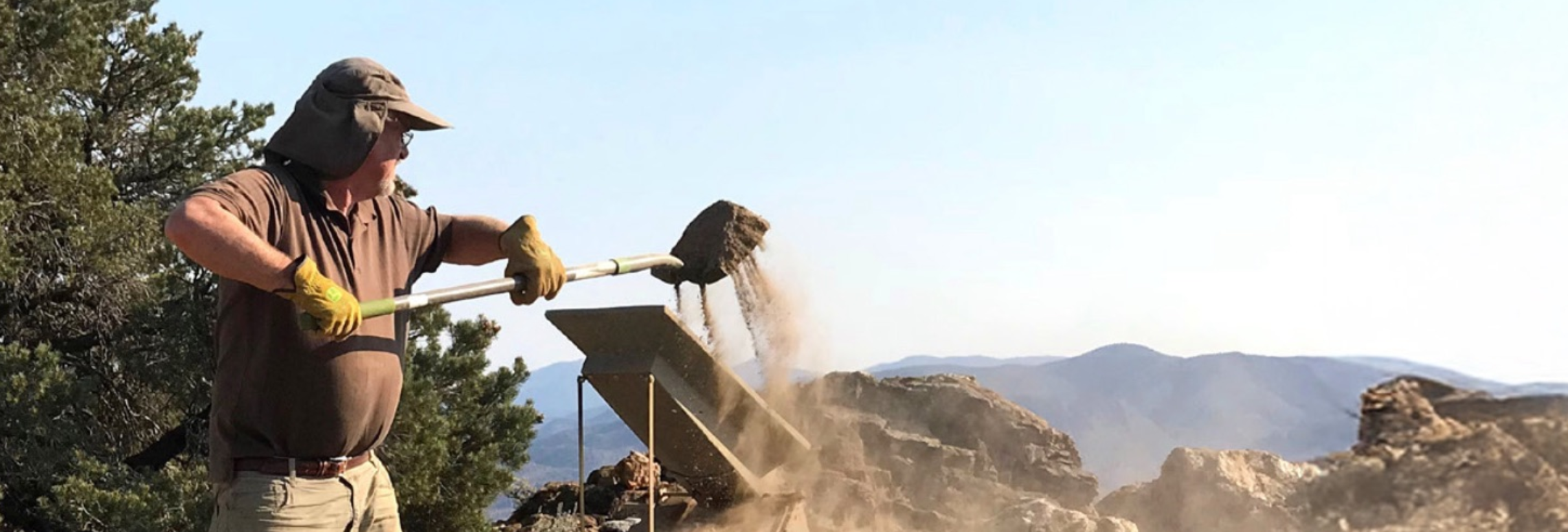
Today, the antique stamp mill and much of the other mining equipment at the Crisson Gold Mine remains operational. Miners still feed the mill with wheelbarrows of rock, breaking up the larger pieces with sledgehammers. The mine offers gold panning and trommels for serious gold miners. These machines separate the gold from black sands at a much more efficient pace than simple panning. By using trommels, miners can process several buckets of material in less than half the time it takes to pan. Visitors can buy five-gallon buckets of freshly crushed ore and pan for gold or gems onsite. As well, bags of ore that can be taken offsite are available for purchase.
"You can pan for gold at the mine or you can take the ore home with you and pan it out later," Ray said. The use of the trommel is free when you purchase six buckets of ore or more. The Rays also sell high-grade concentrated gold ore, including 15-gallon to one, 30:1 and 75:1 concentrate. Customers can purchase the high-grade gold ore and have it shipped to them.
Gem grubbin'
Crisson Gold Mine also offers gemstone grubbing — rubies, emeralds, sapphires, crystals, amethysts, garnets and other minerals. This dirt is shipped in from Franklin, North Carolina, famous for its rubies and sapphires. Many lucky gem hunters have found high quality precious stones and had them made into jewelry, Ray said.
If you go:
Both Tammy and Tony Ray have been members of the Lost Dutchman's Mining Association and Gold Prospectors Association of America since 1992. The Crisson Mine is a short drive from the Loud Mine LDMA Camp, near Cleveland, Georgia. It is a must-see for GPAA and LDMA members.
For more information about Crisson Gold Mine, go to www.crissongoldmine.com. Nearby attractions such as the Dahlonega Gold Museum and Consolidated Gold Mine are definite bucket-list destinations for anyone with even the slightest case of gold fever.
Those interested in learning more about the history of gold mining in Georgia will find any of the books by Anne Dismukes Amerson well worth reading.
According to The Georgia Gold Rush, a book by author David Williams, geologists have confirmed that "veins rich in gold do indeed lie undisturbed in these Appalachian foothills." Perhaps, another Georgia gold rush is not far off.
Brad Jones is the Managing Editor of Gold Prospectors magazine. He can be reached at bjones@goldprospectors.org.
- Article as featured in the May/June 2012 issue of Gold Prospectors magazine
GPAA News
Legends of Crisson Gold Mine
From piracy and peril to pure Georgia gold
Not far from Dahlonega, lies one of Georgia's oldest gold mines, steeped in some of the state's richest history — and color.
Share this article
Spread the word with your prospecting community.
.png)