From the Gold Prospectors May/June 2014 issue
By Brad Jones
Widespread drought reported in California this spring led to a new gold rush in parts of California. With less area covered by water, gold is more accessible. It's only logical.
In February, when reports of the impending drought began to surface, some prospectors began noticing that gold was easier to find in some places. Existing gold once covered by water is now easier to access.
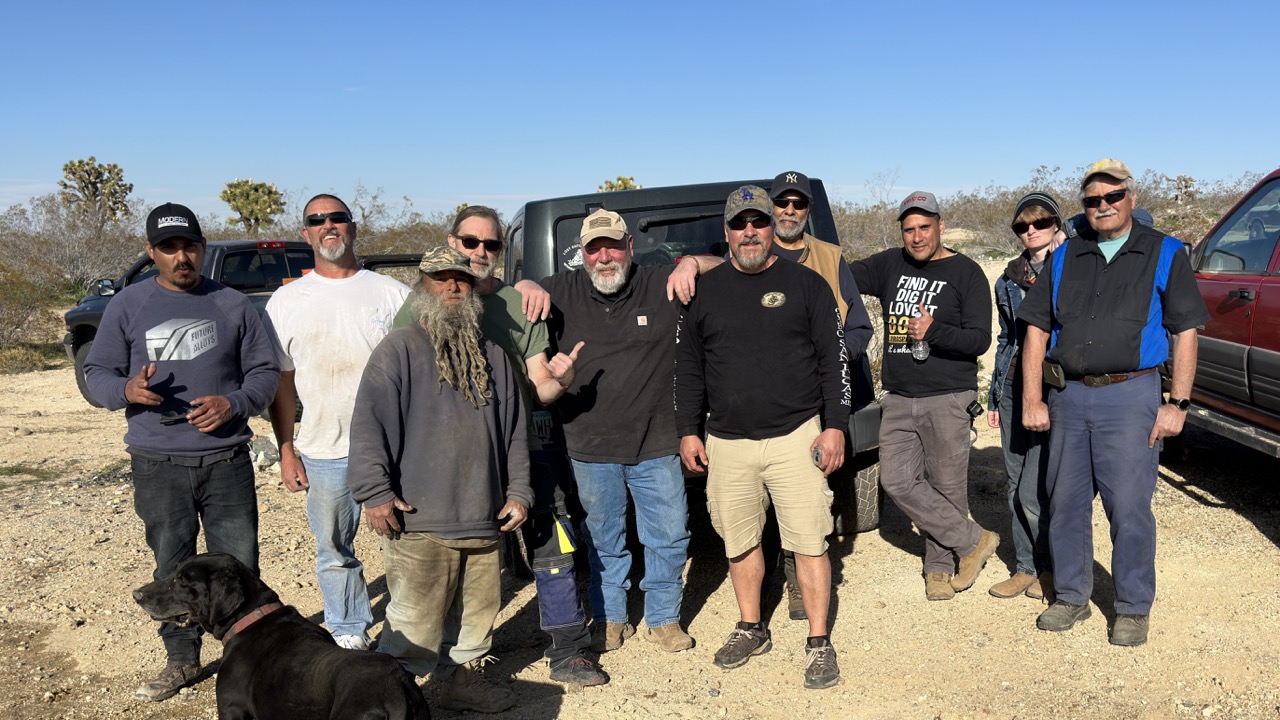
After receiving several calls from the news media about the so called "mini gold rush," the GPAA's Kevin Hoagland and a dozen or more members set out to a GPAA claim near Fontana, Calif.
In February, when reports of the impending drought began to surface, some prospectors began noticing that gold was easier to find in some places. Existing gold once covered by water is now easier to access.
Some of these local GPAA chapter members were Temecula Valley Prospectors President Jack Barber, Hemet Valley Prospectors President Arnold Shields and Route 66 Gold Miners Vice-president Max Maxilom, among others.
Within an hour or so, these experienced and avid prospectors began finding pickers and fine gold and TV reporters were quick to broadcast the news of their finds. Suffice it to say that in tough times like these, the news media seems starved for a "feel-good" story to give viewers a glimmer of hope in what appears to be an otherwise bleak economic outlook.
Then, the unthinkable happened — a weekend downpour that amounted to about three inches of rain over just a few days. The rainstorm changed the discussion from "drought gold," to flood gold and what this means for gold prospectors.
As is typical in California with its sudden, heavy rainfall and flash floods, the weekend precipitation didn't wash away the forecast of drought in terms of water shortages, but it undoubtedly moved and replenished placer gold deposits in streams hit the hardest by flash floods.
When it drought, get your pan out
Nobody wants a drought. It's hard on farmers, and in the semi-arid to desert climate in much of California that depend on annual snowfall in the Sierras and other areas, water shortages shouldn't be taken lightly. Though California is known for its mountains and beaches, much of the state is semi-arid to desert. Those conditions, combined with such a large population, make water conservation inevitable.
When all is said and done — whether we want a drought or not — we are faced with one. As they say, 'When life gives you lemons, make lemonade.' Or for those who don't live in citrus country, 'Make hay while the sun shines." So, grab your pan and enjoy the spoils of gold that Mother Nature has made easier for you to find during the drought.
How gold migrates through weathering, erosion
Different types of naturally occurring events such as weathering, erosion, floods, droughts, earthquakes and forest fires affect the way gold migrates.
For placer gold miners, water erosion is the most relevant and the most important to understand in terms of how and where to look to find the most gold.
Weathering breaks down and sculpts the rocks and erosion transports the fragments — including gold. To illustrate, think of a rainy day in the high altitudes. Water pools in crevices in the rock. By nightfall, as the temperature drops the rainwater freezes, forming ice that expands and forces the rock to separate even more. This freezing water, though much slower, acts like an ax or sledgehammer and wedge that you use to split wood for your campfire, for example. The next day, the warmth of the sun melts the ice and the cracked fragments of rock are washed away by wind, gravity and water.
Thus, jagged mountain peaks become rounded hillside, boulders become smaller stones and smaller rocks eventually become gravel, sand and finest sediment we find in river and stream deltas, where the water and gold settles. Weathering and erosion reveal the marvels of geology from boulders that tumble down from the highest mountains to the smallest particles of gold waiting for you to discover.
Lode and placer gold
At the risk of oversimplifying to explain different kinds of gold, it is first necessary to understand the migration of gold, through erosion from the lode source.
Lode gold is still lodged typically in a quartz vein, for example. It hasn't eroded away from the lode source.
If you find quartz, it's a lode; if you find gold in it, it's a vein; if its eroded, it's eluvial (no watercourse yet).
As rock erodes, the gold is gradually dislodged from the lode source and smaller pieces of gold break off and migrate through water erosion. When this smaller gold reaches a stream, it's called alluvial placer gold.
Gold by any other name ...
Gold by any other name is still gold. It remains "Au" on the periodic table of elements. And, the only element heavier than gold is platinum. Gold is more than 19 times heavier than water, which explains why you can pan off the lighter material and find gold in the bottom of your pan. It's only physics and common sense.
Panning is the oldest known method of mining gold. The first recorded instances of placer mining occurred in ancient Rome, where gold and other precious metals were extracted from streams and mountainsides using sluices and pans.
So, don't be confused by the terms that follow. Gold is still gold, no matter how or where you find it. And, melted down to its purest form, gold is worth the same worldwide and measured by the troy ounce. A large, well-shaped nugget with a nice texture and sheen can often be sold as a specimen, which would have a higher value on the open market.
The price tag put on a gold or gold-laced quartz specimen is determined only through the eyes of its beholder, which can range anywhere from priceless (not for sale) to the what the highest bidder is willing to pay and what the beholder sees as a fair cash value.
Drought gold
Drought gold, a term I just invented (I think), is best described as gold that's no longer underwater and is exposed. In some ways, that means easy pickin's for those who have the gumption to head out to the dry country and look for it. Bring your metal detectors, sluices and pans.
Flood Gold
Flood gold is gold that has been washed downstream in a storm or flash flood. It's often found in pockets or in unexpected places, especially if the deluge stops abruptly, no longer able to carry the weight of the heavy gold downstream in the direction of flow. When the water flow begins to slow, the gold drops out of suspension, starting with the largest and heaviest pieces.
Flood gold is often found on the top a layer of sediment that was deposited during an earlier flood. How far the gold moves away from the stream channel depends on the magnitude of the flood and the size (and weight) of the gold. Larger floods will disperse gold over greater areas. It is often found resting in a flood layer up off the bedrock.
It requires much less water volume and velocity for Mother Nature to move sand-sized particles downstream than it does to move flakes, pickers or gold nuggets in the same way it takes more water force to move sand, gravel and boulders — only gold is much heavier than ordinary rock. So, the larger the gold, the more water force it takes to move it downstream.
Gold that is particle-size such as fines, flour and even gold "dust," can also be swept downstream floating on the surface barrier or in suspension because of the speed at which the stream or river may be flowing, especially during spring runoff and during heavy rainfall. Too small for your poke, these tiny particles (though widely dispersed) can mean ounces of gold in your vials over time if you're patient, have the right equipment, prospecting know-how and are willing to work for it. Nobody ever said recovering fine and flour gold was easy, but it can be enjoyable with the right set of skills and attitude.
The larger gold is typically (but not always) found at the bedrock of streams and riverbeds. This gold will remain trapped in a gold catch until a large volume and velocity of flood water is strong enough to dislodge it and move it downstream. Some floods are so powerful and the resulting water erosion so great that they loosen large rocks and huge boulders, which can come crashing downstream, not only releasing trapped gold but splitting other rocks, leaving jagged edges and even scouring, cracking and breaking the bedrock. These large flooding events move massive amounts of large gold, create new gold catches and can even alter a stream's current or direction of flow. These broken and jagged edges of rock, trap the most gold.
While Mother Nature works hard to veil her treasures, she also makes it interesting by moving and replenishing placer gold deposits from her hidden sources.
Pocket Gold
Pocket gold is gold that has eroded from its vein, but has not yet reached the river or stream. Some prospectors say that real pocket gold can appear black or rusty in color on its surface until it's bleached with sodium hypochlorite. Then, it will appear yellow with agitation.
In a mining blog I read somewhere, a miner mentioned that author Robert Ballantyne once wrote a manual about how to find pocket gold. According to the blog, Ballantyne explains in detail how to follow gossan down to great catches of pocket gold.
Wikipedia defines gossan is "intensely oxidized, weathered or decomposed rock, usually the upper and exposed part of an ore deposit or mineral vein. In the classic gossan or iron cap all that remains is iron oxides and quartz often in the form of boxworks, quartz-lined cavities retaining the shape of the dissolved ore minerals. In other cases quartz and iron oxides, limonite, goethite and jarosite, exist as pseudomorphs replacing the pyrite and primary ore minerals. Frequently gossan appears as a red stain against the background rock and soil due to the abundance of oxidized iron and the gossan may be a topographic positive area due to the abundance of erosion resistant quartz and iron oxides. Although most gossans are red, orange, or yellow, black gossans from manganese oxides such as pyrolusite, manganite, and especially psilomelane form at the oxidized portion of Mn-rich mineral deposits. In the 19th and 20th centuries gossans were important guides to buried ore deposits used by prospectors in their quest for metal ores. An experienced prospector could read the clues in the structure of the gossans to determine the type of mineralization likely to be found below the iron cap."
If I had to guess, I would say that gossans are still important today. The blog went on to say that the old-timers believed pockets came in threes. So, if they found a fissure and located a pocket within disseminated bedrock or in say decomposing hematite pockets like those found in the Inyo Mountains of Eastern California, they believed the top pocket was just the beginning of the paystreak. They would keep digging for the third pocket, which was believed to be the richest deposit.
The thrill of the hunt
Hunters know that the more they understand about the habits of their prey, whether it's a deer herd's favorite watering hole or feeding patterns, the better their chances of eating venison and deer steaks over the winter.
Though a much, much slower moving and less intelligent target than deer, gold is the prey and prospectors are the hunters. You have to know the migration habits of gold, where it hides and how it can be camouflaged in the dirt and black sands to be successful.
The '49ers
Gold prospecting, though it requires hard physical work and skill, has always held hope for those who enjoy getting outdoors and don't mind a little sweat and elbow grease. The discovery of gold in 1848 on the banks of the American River in Coloma, Calf. at Sutter's Mill set off a gold rush like none the world had ever seen. The gold prospectors, known as the '49ers of the California Gold Rush (1849-1855) who came from all walks of life and from all over the world, were such hardy people. While some had nothing to lose, others had families they left behind in the hope of striking it rich and providing a better life for themselves and others.
The '69ers
More than 100 years after the California Gold Rush, George "Buzzard" Massie founded the Gold Prospectors Association of America in his garage in 1968. By the next year, Massie, his wife, Wilma, and their two young sons, Tom and Perry, had begun to build a family-run empire.
In the years preceding, George Masssie struggled the same as most working-class people to earn a decent living for his family. He escaped the clutches of Los Angeles and traveled the country in search of gold from L.A. to Idaho, to Georgia, the Carolinas and Alaska to build a membership-based gold prospecting empire. He succeeded. And, it all started with a little gold fever, believing in himself and the support of his family.
George Massie and his boys hauled more than 800 ounces of gold out of one canyon in one summer that set the stage for the expansion of the GPAA, LDMA, the Alaska Gold Expedition, Gold Prospectors magazine, the Pick & Shovel Gazette, Outdoor Channel, Gold Fever and other TV shows.
In 1993, George passed that legacy on to his wife, Wilma, and sons Tom and Perry, who've since passed on the legacy to their children. Wilma passed away, Perry has retired and George's youngest son, Tom, picked up the GPAA flag and has carried on the family business and tradition. Today, his stepson, Brandon Johnson is the president of the GPAA and Lost Dutchman's Mining Association. Though the Outdoor Channel was recently sold, Tom Massie continues to be involved in the GPAA, LDMA and keeps busy mining and filming his ever-popular TV show, Gold Fever, which still airs on the Outdoor Channel.
As long as enough people continue to see the joy and excitement that the gold prospecting lifestyle can offer everyone from young families with children to retired individuals and couples, the GPAA and LDMA communities will continue to thrive and grow. Just like George Massie encouraged others to get outdoors and discover the joy and excitement of gold prospecting, Johnson has invited newcomers to join and get involved in a local GPAA chapter or participate in the new direction of LDMA camps.
The '09ers
Just about the time he took the helm of the GPAA, Johnson faced a new culture of environmental extremism that swept California and other parts of the country, which is exactly the kind of fanaticism his grandfather, George Massie, had warned us about not so many years ago. In 2009, California state legislators imposed a two-year moratorium on suction dredge mining which is still lingering in the court system at the time of this writing. These are not easy times for gold prospectors despite gold reaching historically high prices.
We all enjoy the public lands in the western United States where we can prospect and mine for gold, gems and treasure or even stake our own mining claims. But today, access to those public lands is being eroded by a deluge of government-imposed restrictions.
Gold prospecting isn't how most GPAA members earn a living. Most of us have day jobs, own businesses, are retired or have a lifestyle that allows us the opportunity to spend time outdoors. Others are lucky enough to reside in the backcountry near a GPAA claim or live near an LDMA Camp. For some of us, gold prospecting and small-scale mining supplements our income. For others, gold is their only source of income. Still others manufacture and sell gold prospecting equipment you see displayed at the Gold & Treasure Expos.
Unlike reality TV shows and other publications about gold prospecting and mining, the GPAA provides a network of prospecting and mining clubs we call local GPAA chapters.
These chapters are listed near the back of this magazine and are free for our members to join. The GPAA provides mining claims for members and the LDMA provides deeded properties and mining camps for its members — places where you can prospect for gold that is yours to find and keep.
If you are already a GPAA member, you may want to consider joining a local chapter to make the most of your membership and help us help you find more gold!
Back to the future
The more high-tech society becomes, the more relevant gold has become in the manufacture of computers, cell phones and other products we use daily — more relevant perhaps than it was to the ancient Romans who first panned for it. Whether gold is used as currency or not, it's still worth its weight in ... well, gold!
The GPAA is dedicated to promoting the hands-on heritage of the North American gold prospector and the living legacy of our founder, George Massie. If you'd like to join us, go to our Membership page or call 1-800-551-9707.
Brad Jones is the Managing Editor for the Gold Prospectors Association of America. He can be reached at bjones@goldprospectors.org.
Sizes of Gold
Learning the Lingo
- Specimens: A naturally formed large gold nugget or gold-laced quartz specimen.
- Nuggets: A naturally formed lump of gold that's big enough to put in a poke and likely won't fit in a typical small vial, depending on its shape.
- Pickers: A piece of visible gold large enough to easily pick up with your fingers.
- Flakes: A piece of gold that is large enough to easily spot but is difficult to pick up with your fingers.
- Fines: Particles of gold that are too small to pick up with your fingers.
- Dust: Gold dust, very, very fine particles of gold that resemble dust.
- Flour: Gold particles that are barely visible to the naked eye.
- Micron gold: Gold particles that are invisible to the naked eye.
- Color: Any amount of visible gold — usually smaller than a nugget — that you find in your pan.
Everything is either grown or mined. Just think about it!
"Remember that there's only two places everything comes from. It either comes from minin' it, or growin' it." - George "Buzzard" Massie
- Grown: Lumber and any wood products. Food and fabric sources, vegetables, fruit, wheat and cereal crops, canola and vegetable oils. Also domestic livestock such as cattle and wildlife such as fish and free-roaming animal herds. And, the list goes on …
- Mined: Minerals and fossil fuels used in transportation, heating and cooling. Plastics, metals a precious metals used in the manufacturing of every product known to man, including medical equipment, all vehicles electrical and gas-powered motors, tools, machinery, utensils, jewelry, computers, TVs, cell phones, radios, air-conditioners, electrical wiring and household appliances — washers, dryers, dishwashers, ovens, microwaves — literally everything and the kitchen sink.
.png)